Howe Gelb

Press

Howe Gelb: Smelling The Smoke Of A Future Fire

The Brooklyn Rail review:

by KK Kozik

New York, NY February 5th, 2014

“I can make this bold statement now,” pronounces Howe Gelb, “because I’m well over 50 and we’re allowed to come to conclusions: music in its most pure form is in a state of evolution constantly. I believe that whatever you are doing, however you are playing, it has to keep changing. It is always on its way somewhere. Whatever the music wants from you it will apply itself through you.”

If this seems abstruse for rock ‘n’ roll, that is Gelb. The self-described desert-hillbilly rocker appears on 40 to 50 albums—solo, with his main band, and collaborating with groups from a Canadian gospel choir to Andalusia’s A Band of Gypsies. On his recent The Coincidentalist, Howe tiptoes around a Beat-like faith in the unknowable. If a “coincidentalist” is a medicine man, a seer of signs that mark a trail, then the album is another episode in a meandering story that started with a flood.

In 1972, when Gelb was a teen living with his mother in Wilkes-Barre, Pennsylvania, the Susquehanna River overran the levees, inundating their house. Plan B sent Gelb and his brother to the desert home of their recently remarried father. That a contrast of extremes can provide grist for creativity is hornbook, but when Gelb, playing piano, first jammed with Rainer Ptacek on resonator guitar, his music took flight. Despite, or because of, the acid trip he was on, Gelb perceived with clarity that he and the East German Ptacek “had entered some kind of a sacred sonic bond … he the older brother I never had and didn’t know I so very much needed.”


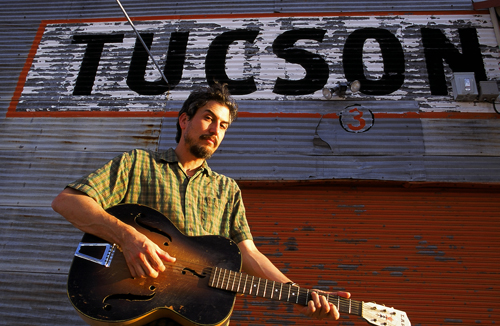
Howe Gelb. Photo by KK Kozik.


They formed a band, and a dynamic Tucson music scene coalesced around them. The shape-shifting group became Giant Sand (recently Giant Giant Sand), but Ptacek died in 1997, a loss Gelb still feels keenly. “Everything I do that makes the most sense comes from my time with Rainer. All my wild card ideas are from my own muckaluck, but all the … substantial and rooted, zen values came from Rainer. Things would be a lot better if he was around.”

Gelb followed where his musical interests led: the new boxed set of his solo oeuvre, Little Sand Box, documents these perambulations. Always, Gelb’s quirkiness shines through. “In the beginning I made abilities out of my [limitations] and that gave me a sound. … People would say, ‘It sounds weird because it’s made in the desert and it’s hot out there.’ They would come up with excuses for why it [wasn’t] normal or regular … it was just all I could do.” Gelb is ambivalent about the recordings: “When you hear [one], it’s just what happened that day. It would be totally different the next day and it’s how I play every night. I just travel by instinct … whatever I think is good at that time, I try to deliver.”

The Coincidentalist finds Gelb taking his intuitiveness to a new level. “I’m using this method of lyric writing now where … I just let it flow up and usually it doesn’t make any sense and then later it makes some sense and later still it comes true. You have to be open to the happenstance.”

The most potent happenstance on the album is the echo of another musician. From the first growled couplets of “Vortexas,” (“it used to be much cheaper / to find a love and to keep her”) links to Leonard Cohen are easy to find. Surprisingly, Gelb had never thought much about Cohen. It was only after the album had been recorded that Gelb read Sylvie Simmons’s biography of Cohen and the impact hit. “Smell[ing] a smoke from a future fire” is Gelb’s phrase for that phenomenon.

The album leaves more questions than answers. The songs toy with musical tropes: classic country music, spaghetti-western soundtracks. The background vocals are off-kilter and Gelb’s voice often heads in different, thought-provoking directions from standard rock ‘n’ roll. The effect is something like what Cohen terms “charged speech,” the derashas he heard in temple as a child, meant to have gravitas and mystery. Gelb was exposed to the same evocations and considers himself Cohain, of the lineage of Jewish priests descended from Aaron. These reverberations come through in Gelb’s poignant, half-solemn musing on mortality and loss, “Picacho Peak.” He sings, “When I was a child / my daddy taught me how to steer with my knees / Since he left this world it hasn’t felt right.”

“Cohain-wise … There is a ritual […] passed down from father to son … But since my father’s father died so young …My dad didn’t have the ritual to pass on to me. So I’m left with just the DNA imprint. I’ve given some thought as to how it all manifests in the things we do or gravitate to. […] I do allow the inkling of trajectory to possibly help with understanding where this music comes from.? Its just me pondering … Searching for clues, but never ever convinced by any of them … Just keeping an open mind to the possibilities … never relying on them.”
 

“A Little Sand Box” of Howe Gelb


January 3, 2014 |   ZOCALO MAGAZINE
One of Tucson’s landmark songwriters – guitarist and pianist Howe Gelb – has had an astoundingly strong and quirky musical career with a prolific output that is near impossible to categorize.

Howe Gelb photo courtesy Fire Records

photo by Bill Carter


Gelb is a musical sound creator with a hand in crafting over fifty albums. “Little Sand Box” only covers eight of his solo releases that span the stylistic gamut from eerie desolation to soul lifting hope to piano jazzy.

Through most of his work, Gelb has a steady, wry song–talkin’ lyrical approach, and a passion to collaborate with varied musicians of the first water, with whom, in his words, “I would get sparked when we’d jam.”

Much of Howe’s prodigious productivity has been as a solo act. His solo material, like the acclaimed 2006 release, “Sno Angel like You,” puts Howe’s Americana in juxtaposition with a gospel choir; years later finds Gelb collaborating with Spanish flamenco virtuosos on 2011’s “Alegrias” release. And then it’s his burning passion for piano instrumentals that lulls listeners into a reverie with the disk “Some Piano.”

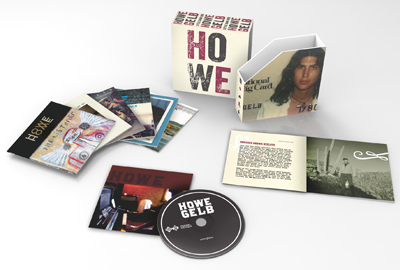
This month, British music label Fire Records releases a massive eight volume box-set, appropriately named “Little Sand Box,” containing previously released albums, re-mastered by Tucson’s Jim Blackwood and augmented with bonus tracks that may have been overlooked in the sheer volume of Gelb’s career output.

Howe’s intimate, elucidating and in-depth liner notes/booklet guides the listener and reader through two decades, 1991 through 2011, with styles ranging from indie rock, Western weird and slow-core to European blues, soul, and flamenco played and produced in Denmark and Spain; and many, many life changes.

Herein, described in song, are moments of the songwriter’s life, from wooing a wife – in 1991?s release “Dreaded Brown Recluse,” Actually Faxing Sophia, to his child’s voice, about to be told in Blue Marble Girl, on 2001?s release “Confluence” and the break-up of Giant Sand and its aftermath on two versions of the songVex on that same release.

For Gelb, music comes from life. The “Listener,” a 2003 release, is full of tremendous work with talented Danes, began from pre-life – as he writes in the liner notes: “It started out by going to Denmark to have our third child… about fourteen musicians showed up when I went in to record… by the time we finished the album, three were left standing when the dust settled … and these three would accompany me on the road to support the album…I would soon realize that this was becoming Giant Sand again.”

Or taking a chance late in the evening to chat up a choir in Ottawa, Canada, to see if a collaboration could be at hand.“I was so tormented that I didn’t make a connection with any of the choir people.”

Gelb had been invited to the Ottawa Blues Festival, as Gelb puts it, “for some reason.

“I just had to do something, so I went out into the beautiful July rain. I went in and sat down and caught the last couple songs and got dizzy again… transfixed… stunned with joy. I finally worked up the guts to find the director of that specific church… and approached him with my idea.”

The resulting 2006 release “Sno Angel Like You,” re-released on this box set with two bonus tracks and accompanied by the 2009 formerly limited release of the live Ottawa show “Sno Angel Wingin It,” are, for this listener, the most powerful materials in the set.

The collaborating choir – Voices of Praise Gospel Choir – soar and growl in perfect contra punt to the songwriters’ sung and spoken words. This album feels good like gospel should, and the live release, with five cuts not on “Sno Angel” proper, is by itself, worth the price of admission.

As Gelb says, “the result is a fine audio postcard of the excitement that a gospel choir can radiate on stage and on the road… a real blessing.”

Howe Gelb's box set spans over two decades of his music. photo courtesy Fire Records, FireRecords.com

Howe Gelb’s box set spans over two decades of his music.
photo courtesy Fire Records, FireRecords.com

In order, the box set is comprised of “Deadly Brown Recluse,” “Hisser,” “Confluence,” “The Listener,” “Sno Angel Like You,” “Sno Angel Wingin’ It,” “Allegrias” and “Some Piano.”

“Some Piano” especially caught my ear. Gelb spent mucho time as an evolving pre-adult listening to quality piano blues and jazz, and it is – despite Howe’s self-deprecation in his liner notes, “the black notes had me stumped,” and “my ear was tin” – performances shining gorgeously in these evolved tracks, culled from Howe’s previous piano releases “Lull,” “Ogle,” “Spun” and “Snarl.”

All in all, the mostly re-mastered eight disc box set is a feast for either a dedicated Howe Gelb fan or one perhaps not yet in the fold. Music made in Canada, Spain, Denmark, but most of all, in Tucson, from a Tucsonan.

The box-set is set for release on Jan. 14, at local record stores or from Fire Records. More information is available at FireRecords.com or HoweGelb.com.

LA TIMES blogger Randall Roberts weighs in…

Essential TracksHowe Gelb (Jane Mingay / New West Records)
By Randall RobertsDecember 2, 2013, 12:40 p.m.
 Over 30 years and nearly as many albums, Arizona songwriter Howe Gelb has walked a singular path, one that has drawn a cultish following devoted to his guitar- and piano-based wanderings. He got his start as part of L.A.’s country punk scene with Giant Sand in the early ’80s but hit the desert and has since released a string — nay, a rope — of underappreciated curios. “I’m a Vortexan at heart,” he explains in “Vortexas,” and he’s right: Twang-accented but structurally cubist, the songs on his new album often travel wormholes few songwriters dare.

To admire Gelb is to fully expect, for example, that a song like “Triangulate” will begin with a basic structure — only to spin into an utterly baffling chorus and tunnel elsewhere. Featuring guest appearances by guitarist M. Ward (She & Him), Bonnie “Prince” Billy, KT Tunstall and Sonic Youth drummer Steve Shelley, “The Coincidentalist” may be an angular first listen, but spending the time to adjust to its environment is well worth it, and you may soon realize how warm and inviting a realm it can be.

http://www.latimes.com/entertainment/music/posts/la-et-ms-ca-essential-tracks-howie-geib20131201,0,4417008.story#ixzz2mQuTaUG0